Between the Font and the Grave
“I could be bounded in a nutshell and count myself a king of infinite space.”
Stratford-upon-Avon is a Shakespeare lover's dream, though the town leaves little room to forget whose dream you've entered. Shakespeare is everywhere. Bronze and stone. His name over buildings, shops, theatres, institutions. You can walk through the house where he was born. At the Shakespeare Institute, I watched a young scholar in the conservatory unpack her lunch from a Trader Joe's bag, four hundred years and an ocean away from anything he would have recognized. Actors perform his plays a few blocks over. Tour guides dress up as him. Swans glide past the theatres and the church spires.
It's beautiful, a little theatrical, a little surreal. The image that keeps scratching my brain, though, isn't the statues or the river. It's a photograph I took inside Holy Trinity Church.
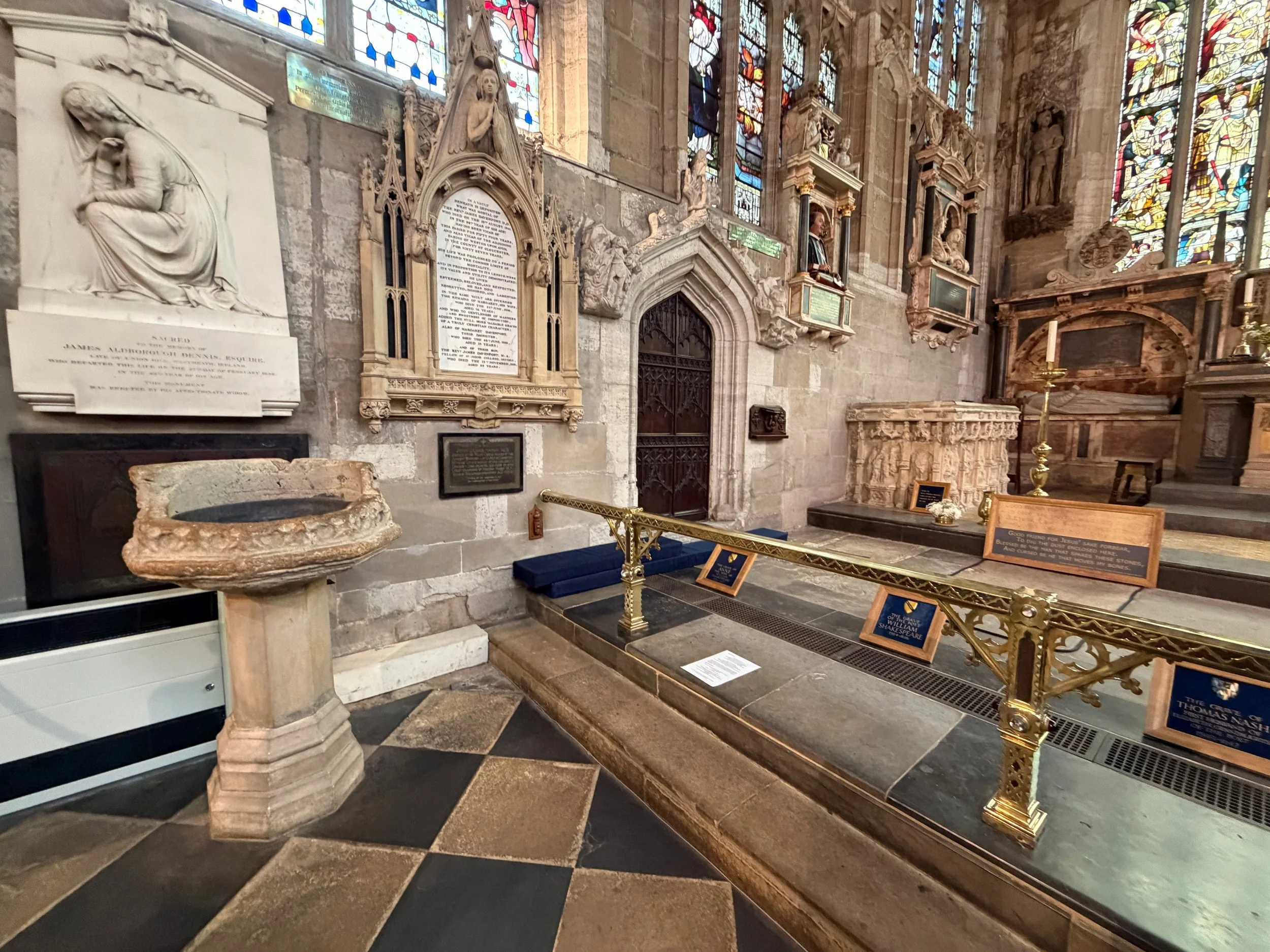
Near Shakespeare's tomb is the medieval font where he was baptized, according to the kind docent. The beginning and the end of his life, a few steps apart, within the same frame. An entire human existence compressed into a few feet of space. I found that sad.
Not the sadness of a wasted life, though. He was prolific and strange and successful beyond what anyone could have predicted. His plays outlived him by centuries. His language got inside other languages. People still read him, argue about him, stage him in a hundred countries and a hundred forms. By any reasonable measure, his was an enormous life. Standing in that church, it still looked small.
He was born in Stratford, baptized there, raised there, married there, buried there. He worked in London, but Stratford was the place he would return to. There's no evidence he ever crossed the Channel, let alone reached Venice or Verona or Vienna or the Denmark of Hamlet's castle. He wrote of Egypt without having seen it. His geography was small, but his imagination wasn't.
I've always thought of travel as an expansion, a way of proving to yourself that your own life isn't the only possible one. To move through the world is to encounter a life built on different assumptions than your own, and to feel, briefly, how thin the illusion of universality really is. It cracks open certainties you didn't know you were carrying, the ones you never had to defend because no one around you ever questioned them. We treat the passport almost like a report card, evidence of growth. We count countries. We speak of "seeing the world" as if being physically present in a place is the same as understanding it. Sometimes it is. Sometimes someone crosses fifty borders and comes home having learned nothing at all.
Shakespeare undercuts the idea that movement and insight are the same thing. He understood an enormous range of human experience without needing to live inside most of it. Ambition, humiliation, loyalty, betrayal, grief, jealousy, the particular cruelty of fathers toward daughters. His characters lie to each other and to themselves in ways that still feel accurate four centuries later. His real territory wasn't England or Italy or Denmark. It was human nature, and he seems to have traveled there constantly.
I don't say that to argue against travel. Travel remains one of the most valuable ways to encounter the world beyond ourselves. But the world does not interpret itself. Understanding is not a byproduct of exposure; it has to be built, deliberately, out of what is noticed and what is imagined. Shakespeare paid attention. He read, he listened, he stole from other people's stories and made them stranger and truer. He found whole worlds in the people already in front of him, which is either a comfort or an accusation, depending on the day.
A comfort, because most lives are lived in small circles even now, when a plane ticket is one search away. We go back to the same kitchen, the same grocery store, the same restaurants. Much of life is repetition. The places in which we are born, work, worship, love, age, and die are often separated by far less distance than we imagine.
An accusation, because it means geography was never a good excuse. You don't have to see everything to become curious or perceptive. You can also travel constantly and drag the same narrow assumptions from one airport to the next. Miles were never the real unit of measurement.
There's one more contradiction. Shakespeare barely left home, and now the whole world comes to him. People fly in from every continent to stand where he's buried, to sit through three hours of a play he wrote when Elizabeth I was still alive, to major in sentences he tossed off for money. The guides put on his clothes and walk strangers down streets he would have found completely ordinary.
Stratford was his home, but it became everyone else's destination. He didn't have to go to the world. The work went instead. Even so, the sadness from the church hasn't quite left me.
The font and the grave are still close together. No amount of achievement changes that. You arrive somewhere. You get a limited stretch of time. You leave. Even a life as consequential as his gets reduced, eventually, to two dates and a slab of stone. Fame doesn't beat mortality. At best it leaves an echo loud enough to outlast you. We should all be so lucky.
I think it wasn’t the smallness of his life specifically, but the smallness of every life, viewed from that distance. While you're living your years they feel enormous, stuffed with dinners and fights and jokes only two people understand, and days that seem to matter enormously at the time. From far enough away, though, almost any life collapses into the same handful of facts.
Born here. Lived there. Worked somewhere else. Came back. Died. Buried a few feet from the font.
The distance between the stone where his life started and the stone where it ended does not tell you anything about what happened in between. Inside that narrow space is a version of the world big enough to hold kings and murderers, storms, forests, ghosts, comedy, despair. Words that crossed borders he never did, and reached people he couldn't have pictured. Or maybe he could have.
I thought about Prospero: "We are such stuff as dreams are made on, and our little life is rounded with a sleep." A few feet, floor to floor. What he put in between them is the part no ruler can measure. I mean to measure mine until I have my own stone. Go measure yours.